Being an amateur wine maker, you would think that there isn't the pressure to make wines in a style other than your preference. That you can experiment with new techniques, practices or varieties that may be of interest only to you. The absence of market pressures to produce a wine that appeals to the broadest cross section of the population should permit you to be bold if bold is what you want to be, or conservative if that is your desire. But, that really is not completely the case.
Risk
Trying an interesting wine, made in a way that appeals to you, and you alone could result in cases of wine that only you alone want to drink. Or, maybe you find out that there were good reasons why Army Worm wine has never really caught on
commercially. Natural fermentation or carbonic maceration may not turn out an end product that even you are interested in.
Cost
Not having to sell your wine to wholesalers, or to tasting room customers only takes away half of the economic pressures. Just because no one pays you to make your wine doesn't mean you get to make it for free. The vineyard probably doesn't give you their grapes at no cost just because you are not competing for shelf space against them.
Bottles are expensive, even though you may be re-using used bottles for a portion of your wines.
Family
Most of us don't make wine just for ourselves. We share it with our friends and family. Our family puts up with the smell of fermenting must seeping up through the floor from the garage. Our spouses smile politely having to share space with carboys and racking canes.
Our neighbors kids have to hold off on basketball occasionally because the stemmer crusher is set up beneath the hoop. You don't want to impose all of these inconveniences on them,abuse their charity of tolerance with out producing a wine that they can all enjoy (the neighbors, not their kids).
So, we do all feel pressures to make wines in a style that may not always be our preference. My wife like big oaky chardonnay. I occasionally add more oak that I would normally because I know that is what she likes.
We don't get to make wine just for ourselves. And if we did, we probably would not enjoy making it as much either.
Tim
Saturday, October 18, 2008


Sunday, September 21, 2008
You say tomato, ...
No more renting a crusher destemmer for me.
You can not even imaging my excitement at having a crusher destemmer of my own. No more calling up the winemaking shop, trying to schedule a rental last minute because the grapes are ready. No more having to spend half an hour cleaning the last renter's crud out of the equipment before I can even start.
Sure, there are some downsides.
Ummm, I am sure there are. I just can't think of any. But, I would bet my wife could name a couple. Like another large piece of winemaking stuff taking up space in the garage.
That is here name for it, "garage". That is so quaint, don't you think?
I prefer to think of it as a "Non-commercial Winery" that I allocate some of the space to close family members to park in.
It is the whole: "You say tomato, I say ..." thing.
You can not even imaging my excitement at having a crusher destemmer of my own. No more calling up the winemaking shop, trying to schedule a rental last minute because the grapes are ready. No more having to spend half an hour cleaning the last renter's crud out of the equipment before I can even start.
Sure, there are some downsides.
Ummm, I am sure there are. I just can't think of any. But, I would bet my wife could name a couple. Like another large piece of winemaking stuff taking up space in the garage.
That is here name for it, "garage". That is so quaint, don't you think?
I prefer to think of it as a "Non-commercial Winery" that I allocate some of the space to close family members to park in.
It is the whole: "You say tomato, I say ..." thing.
Saturday, March 29, 2008
Paso Robles
Paso Robles.
This ain't your father's Paso
I hesitated with that sub-title, because in that statement, I am the
father.
Since my college days in San Luis Obispo, Paso Robles has changed from a
sleepy little community of cattle ranches, grain farms, western shops,
what seemed like a disproportionate number of fishing boat shops, and
probably 3 wineries. Now, you can count over 200 wineries in the Paso
Robles area. The downtown was recently described as the next Headlsburg.
That is almost spot on. Paso now boasts several nice restaurants, places
to go for a bite to eat, hang out, have a great glass of wine or beer,
and even a few microbrewery pubs.
Everyone is always tempted to separate wines and wineries into
categories, by their style, their varieties of grapes, the viticultural
or enological processes that they employ, their value, or their
perceived quality. These classifications help us to compare wines or
wineries with others we might feel are similar. Sometimes, it is not
obvious in advance, what group one will fit into because what causes the
wine to have the determining quality is not obvious. But, as we began
tasting our way around Paso Robles, a distinction became apparent. We
quickly noticed that there was an obvious geographical boundary between
two distinct categories of wine in the area. Looking at a map, that
geographic boundary has a label, US interstate 101. The freeway runs
north-south through the middle of town and divides the Paso Robles AVA
into two haves. Comparing the topologies of the two areas, they are
equally distinct.
The east side of the AVA is flat, warm, sunny and arid. In many ways, it
is not too different from the central valley, and their resulting wines
are reminiscent of the wines of the central valley. Higher volume,
higher brix and therefore higher alcohol, less color, less aroma, and
less varietal character. That is not to say that there were no stand out
wines. We enjoyed some from the eastern half of the area, but they were
fewer and farther between. Eberle winery was one of those stand outs.
The west side of the AVA is very different from it's eastern half.
Starting at the freeway and moving west, you quickly move into the
hills. Flat vineyards give way to steep slopes, much less land plantable
with vines, more trees. The fog from the coast, just over the hills,
hangs around in the mornings. The temperature is noticeable cooler, the
soils are different. Where the other side was much sandier, the west
side is much more solid. Limestone and granite make the vines work a bit
harder for their nutrients and water. I am sure it makes the winemakers
work harder for each gallon of juice too. The yields are much lower on
this side, where the east side cal easily pull 4-6 tons of grapes per
acre, one winery on the wast said he was getting less that a ton per acre.
Will the area be divided into two areas, east and west? That subject
never came up while we were there. It may be that the area is keeping
any internal divisions from becoming obvious to the public. Probably a
good move to work together and get name recognition for the area.
A few other observations that we found interesting, huge blends or non
traditional varietal blends were common. A blend of 4 or more different
grapes was common. One wine maker had put together a blend of 7
different varietals. It is hard to believe that this wine was the result
of a methodical and meticulous sampling to find the "sweet spot" where
any change of percentages in one direction or another would diverge from
the optimum blend. It seemed more like it was the result of going
through your refrigerator at the end of the week to find out what you
can put into the pot for a stew to use up what you have on hand. That
kind of blend had no identifiable character.
Many wineries gave their wines "pretty names". These were things like
"Renegade", "Sundance" and "Radiance". This was probably because of the
extensive blending, not allowing them to use varietal names like "2005
Sarah", and a name like "Eight Completely Random Wines Mixed into One
Bottle" doesn't roll off the tongue.
The other interesting aspect of the blending, many winemakers were
blending Bordeaux and Rhone varieties together like Cabernet and Syrah,
or even red and white wines together. Some worked, some didn't. Our
favorite winery of the weekend, L’Aventure. I got the impression that
the owners and winemakers made the wines the did because that was their
choice of wine. Well though out and excellently executed.
Our weekend down there coincided with Zinfandel Festival. That brought
in a lot of tourists. But staying to the
smaller wineries off the beaten path kept the crowds down.
A trip to Paso Robles from the bay area is a short 3 hour drive. Well
worth it. Make a long weekend out of it
This ain't your father's Paso
I hesitated with that sub-title, because in that statement, I am the
father.
Since my college days in San Luis Obispo, Paso Robles has changed from a
sleepy little community of cattle ranches, grain farms, western shops,
what seemed like a disproportionate number of fishing boat shops, and
probably 3 wineries. Now, you can count over 200 wineries in the Paso
Robles area. The downtown was recently described as the next Headlsburg.
That is almost spot on. Paso now boasts several nice restaurants, places
to go for a bite to eat, hang out, have a great glass of wine or beer,
and even a few microbrewery pubs.
Everyone is always tempted to separate wines and wineries into
categories, by their style, their varieties of grapes, the viticultural
or enological processes that they employ, their value, or their
perceived quality. These classifications help us to compare wines or
wineries with others we might feel are similar. Sometimes, it is not
obvious in advance, what group one will fit into because what causes the
wine to have the determining quality is not obvious. But, as we began
tasting our way around Paso Robles, a distinction became apparent. We
quickly noticed that there was an obvious geographical boundary between
two distinct categories of wine in the area. Looking at a map, that
geographic boundary has a label, US interstate 101. The freeway runs
north-south through the middle of town and divides the Paso Robles AVA
into two haves. Comparing the topologies of the two areas, they are
equally distinct.
The east side of the AVA is flat, warm, sunny and arid. In many ways, it
is not too different from the central valley, and their resulting wines
are reminiscent of the wines of the central valley. Higher volume,
higher brix and therefore higher alcohol, less color, less aroma, and
less varietal character. That is not to say that there were no stand out
wines. We enjoyed some from the eastern half of the area, but they were
fewer and farther between. Eberle winery was one of those stand outs.
The west side of the AVA is very different from it's eastern half.
Starting at the freeway and moving west, you quickly move into the
hills. Flat vineyards give way to steep slopes, much less land plantable
with vines, more trees. The fog from the coast, just over the hills,
hangs around in the mornings. The temperature is noticeable cooler, the
soils are different. Where the other side was much sandier, the west
side is much more solid. Limestone and granite make the vines work a bit
harder for their nutrients and water. I am sure it makes the winemakers
work harder for each gallon of juice too. The yields are much lower on
this side, where the east side cal easily pull 4-6 tons of grapes per
acre, one winery on the wast said he was getting less that a ton per acre.
Will the area be divided into two areas, east and west? That subject
never came up while we were there. It may be that the area is keeping
any internal divisions from becoming obvious to the public. Probably a
good move to work together and get name recognition for the area.
A few other observations that we found interesting, huge blends or non
traditional varietal blends were common. A blend of 4 or more different
grapes was common. One wine maker had put together a blend of 7
different varietals. It is hard to believe that this wine was the result
of a methodical and meticulous sampling to find the "sweet spot" where
any change of percentages in one direction or another would diverge from
the optimum blend. It seemed more like it was the result of going
through your refrigerator at the end of the week to find out what you
can put into the pot for a stew to use up what you have on hand. That
kind of blend had no identifiable character.
Many wineries gave their wines "pretty names". These were things like
"Renegade", "Sundance" and "Radiance". This was probably because of the
extensive blending, not allowing them to use varietal names like "2005
Sarah", and a name like "Eight Completely Random Wines Mixed into One
Bottle" doesn't roll off the tongue.
The other interesting aspect of the blending, many winemakers were
blending Bordeaux and Rhone varieties together like Cabernet and Syrah,
or even red and white wines together. Some worked, some didn't. Our
favorite winery of the weekend, L’Aventure. I got the impression that
the owners and winemakers made the wines the did because that was their
choice of wine. Well though out and excellently executed.
Our weekend down there coincided with Zinfandel Festival. That brought
in a lot of tourists. But staying to the
smaller wineries off the beaten path kept the crowds down.
A trip to Paso Robles from the bay area is a short 3 hour drive. Well
worth it. Make a long weekend out of it
Saturday, December 08, 2007
All the wines have been put to bed
If you have kids, you know about getting them to bed. No matter how much planning and preparation, there seems to be a flurry of activity right at bed time. Water, blankets, scary shadows, things they forgot to tell you earlier that now are so important that they can't wait until morning.
It seems like they will never fall to sleep. But, they do and then you can relax and everything seems calm and in their place.
Wine making is like that too. Right after the crush, everything seems to be happening at once. Things that should just be in their place, seem to keep popping back up or are a lot more work and take more time than expected.
But, finally, everything is where it should be, wines have finished fermenting. Barrels are stacked. Paperwork is done and now you can take a breath.
That is where I am now. Taking a breath. Maybe it will have a glass of wine too.
Tim
Saturday, September 08, 2007
The Chardonnay has arrived

In Practice, it is not completely hands off, and requires some active participation to keep the stems that have been removed clear of of the shoot and make sure that everything proceeds as expected.
Grape technology has not progressed to the coffee vending machine stage and I hope it never does. But, I think tools like this allow passionate winemakers to focus on what they love to do, making great wine, and not get bogged down in some of the more mundane tasks. Also, there is probably a benefit to the end product since the time between the grapes being picked and getting into the fermenter can be reduced.
As you can see in the picture, Jason has just dumped a bin of grapes into the hopper and Edwin is seeing that they are coming out onto the shaker tray.
We picked up 400 lbs of grapes today. Packed them into our bins with dry ice for the trip home and stop over at my office until the the end of the day (I have to do some activities that actually generate income instead of consuming it.) Then, this evening, we met back at my place to press it out, sulfite it and let it cold soak for a day. It was much fun.
Tomorrow, I will adjust the chemistry, pitch the yeast and away we go.
We expect the Syrah to come in about 2 more weeks and then Zin after that.
Man, do I love this time of year.
tim
Sunday, August 26, 2007
My new stainless steel fermenter

The new fermenter arrived. After months of waiting, it finally came in, and it is beautiful, stainless and big. I knew that it was going to be big, but standing next to it, it really hits brought it home. 500 liter doesn't sound so big, but when you think about it in gallons, 132 gallons is a lot of wine.
Fortunately, it is a variable capacity tank, so I don't need to use the entire capacity right away.
Maybe next year.
Tim
Saturday, March 24, 2007
Bud Break 2007
That time of the year has rolled around again. Bud break is here and again, all
of the vines are shooting out fuzzy green buds, and even little leaves are
starting to emerge from some of the earliest risers.
The 3 year old vines all seem to know exactly what they are doing, which you
would expect. The exciting thing this year is watching the new vines. This is their
second year, only planted a year ago now. Although they are all across the
board in their growth, what they lack in discipline, they are more than making
up for in vigor.
Now to get the new trellis up so that I can be ready for shoot positioning as the
their growth reaches the next stage.
Cheers;
Tim
of the vines are shooting out fuzzy green buds, and even little leaves are
starting to emerge from some of the earliest risers.
The 3 year old vines all seem to know exactly what they are doing, which you
would expect. The exciting thing this year is watching the new vines. This is their
second year, only planted a year ago now. Although they are all across the
board in their growth, what they lack in discipline, they are more than making
up for in vigor.
Now to get the new trellis up so that I can be ready for shoot positioning as the
their growth reaches the next stage.
Cheers;
Tim
Sunday, December 10, 2006
Early Christmas at the Little Winery in the Back

Yes, Christmas came early for the Little Winery.
I started off with a rental, wooden basket press. You have seen them or used them yourself. A basket of wooden staves, a large crank at the top that compresses the grapes and then the juice runs out through the sides. It was a lot of work and time, but that isn't their main problem.
Being that I rented the press, I never new what the person before me had used it on. He may have used it to press grapes that had who knows what type of wild bret yeast. Or she may have pressed their must after adding a MaloLactic bacteria, which is not unusual. However, I may not want these little critters in my wine. At least not without my choice to put them there. How well did he clean it before returning it. And, being wood, how clean could they actually clean it.
The last few times that I rented a press, I rented a bladder press with a stainless steel basket. The basic configuration of the two types of presses is very similar. You essentially have a large, vertical cylinder mounted on a base that has a spout at one spot. The grapes are loaded in the top and a top plate is attached. But, instead of a large crank that presses the grapes from the top, there is a large, cylindrical rubber bladder in the center.
The bladder is filled through a valve with water from a garden hose. The bladder fills, enlarges and presses the grapes gently and evenly against the sides of the stainless steel basket that has been perforated with small holes to make a screen. After about 45 minutes (half the time of a traditional basket press) the grape must has been pressed into juice or wine. Since the basket is stainless steel, it is easy to clean and sanitize.
At the end of this last season, the wine shop that I rent from told me that they were going to sell their rental press. Now it is mine! Isn't it a beauty? No more planning my pressing around ever other renter at the shop, no more worrying about kind of nasty critter may be left on it from someone else.
I look forward to many, many pressings ahead. And, I will tell you about them as they happen.
Cheers.
Tim
Tuesday, December 05, 2006
Winter in the Back Yard Vineyard
The grapes have all gone dormant for the winter, and just in time too. First frost has been hitting northern California and the vineyard has completely shut down. I expect to do a first round of pruning in a couple weeks, just to make walking though it and weeding easier.
Around the first of they year I will put the new trellis in for the new vines and a high wire for vertical shoot positioning.
On the equipment side, I just got may new bladder press.
Lots of fun ahead
Tim
Around the first of they year I will put the new trellis in for the new vines and a high wire for vertical shoot positioning.
On the equipment side, I just got may new bladder press.
Lots of fun ahead
Tim
Friday, April 28, 2006
My Evil Plan
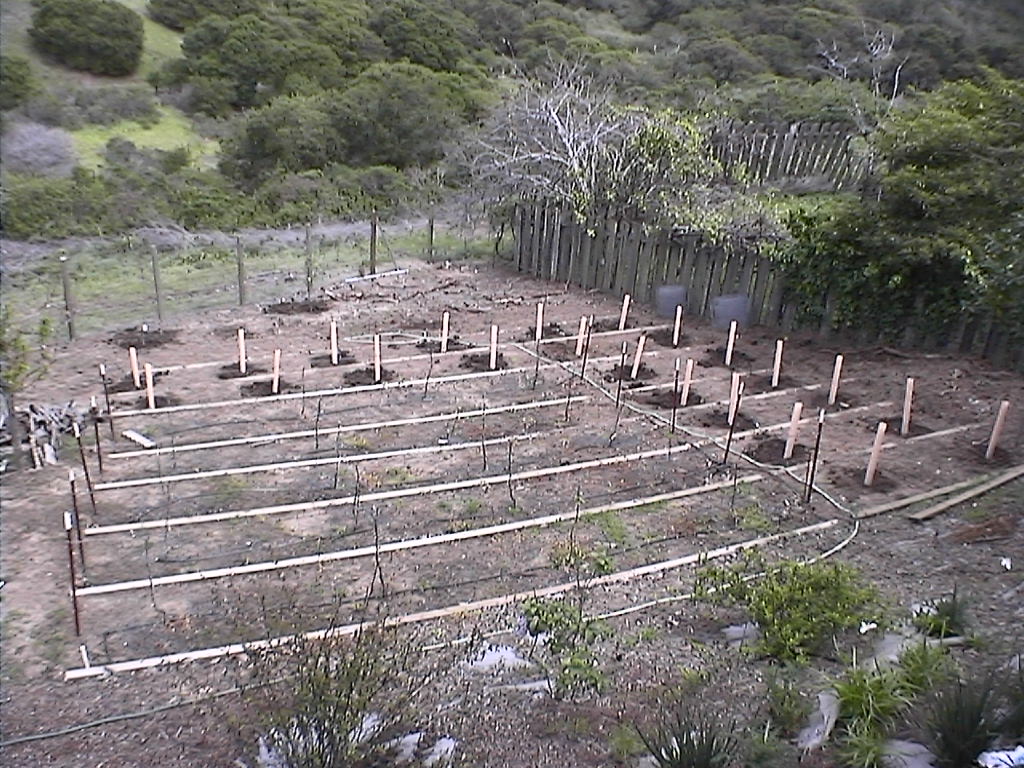 My evil plan to take over the back yard is working!
 BwaaaaHaaaaaaHaaaaaHaaa!
Well not really an evil plan, and not the whole yard, but it is a plan and it is working.
Here was the basic idea:
Infiltration: You plant a few grapes, not too many, but enough that you can actually make something out of it, but not so much that it imposes itself as a major project. You know, it reflects a little bit of an obsessive behavior, but not anything that requires therapy or lithium.
I settled on 20 vines.
Acclimation: Not of the wines, No, the family. It has to become a non-issue. Nothing out of the ordinary. "Vines in the back yard? Oh yea. Hey, how was your day? Wow, this dinner is very good; what is that great flavor. You look great this evening. Oh, hey, I need to run." The new, young vineyard needs to be sheltered from any chance of negative discussion until they have woven themselves into our daily lives like the air we breath.
This is key. The 20 vines must be protected from ill thoughts. It would be so easy to have a discussion pop up as some dinner with family or friends that could undermine the whole plan. It would be a shame to have the whole plan die at this point just because someone wants to use the space for a lawn or something silly like that. I mean really, a lawn, in a back yard.
Let's be real!
The Foothold: The vines have survived the gophers, the rabbits (don't get me started again about the rabbits), the family discussions. Their roots are now extending down deep into the soil and weaving themselves into our daily lives.
The Expansion Groundwork: This is a risky time. I have to do it right. A conversation like this follows: "You know dear? Those vines really look good. They are doing real well too and I think they compliment the back yard well. I may put a few more in. You look real nice this evening!" (then exit quickly).
The Expansion: 22 new vines arrive. About doubling the number of existing vines. Two more rows, two more vines per row. The unusually wet spring let up finally. One reasonably dry day of digging and planting and now I am twice the grape grower that I was a the week before.
This doubling works well. Obviously, doubling can't go on for ever. The math geek in me knows that that is not possible.
But, lets see what happens in another 2 years.
Subscribe to:
Posts (Atom)


 Posts
Posts

