Saturday, November 12, 2005

Autumn weather and colors.


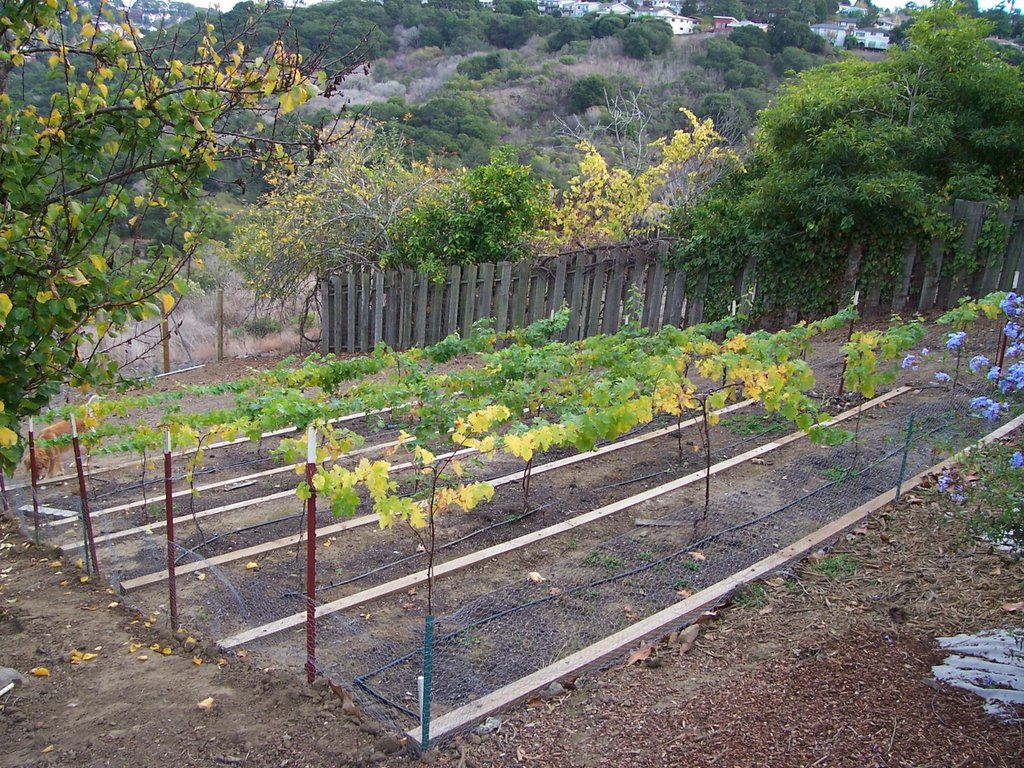
My vines have finally noticed that summer is over. The weather is cooling down and dormancy is soon to come. The leaves are turning from green to yellow. They are using the last bit of sun to squirrel away just a little more sugar into the roots. This is energy for next year's head start.

Grapes are funny that way. Their roots have two growth spurts, one at the beginning of the season, and one at the end. In between theses two flairs of growth, they put all of their energy into making sweet little grapes. Only after they are done focusing on their perfect fruit, do they allow themselves to take the last few weeks of sun to prepare for winter. Then they start shutting down, leaves thin out, chlorophyll, which was keeping the leaves green starts to break down with the decrease in sun, leaving compounds that give those autumnal colors. Compounds with funny names like porphyrins, carotenoids, and flavonoids create shades of yellow, blue, burgundy, maroon, brown and red.

Soon, the vines will be completely shut down and dormant. They will be safely sleeping and protected for the winter frosts. Getting a good, long winter sleep before they need to start all over again next year. What a life.

Tim

Tuesday, October 18, 2005

My one grape cluster.


My young grape plants are just finishing up their second year.

They are all up to the trellis wires and the cordons are all set for next years growth and fruit.

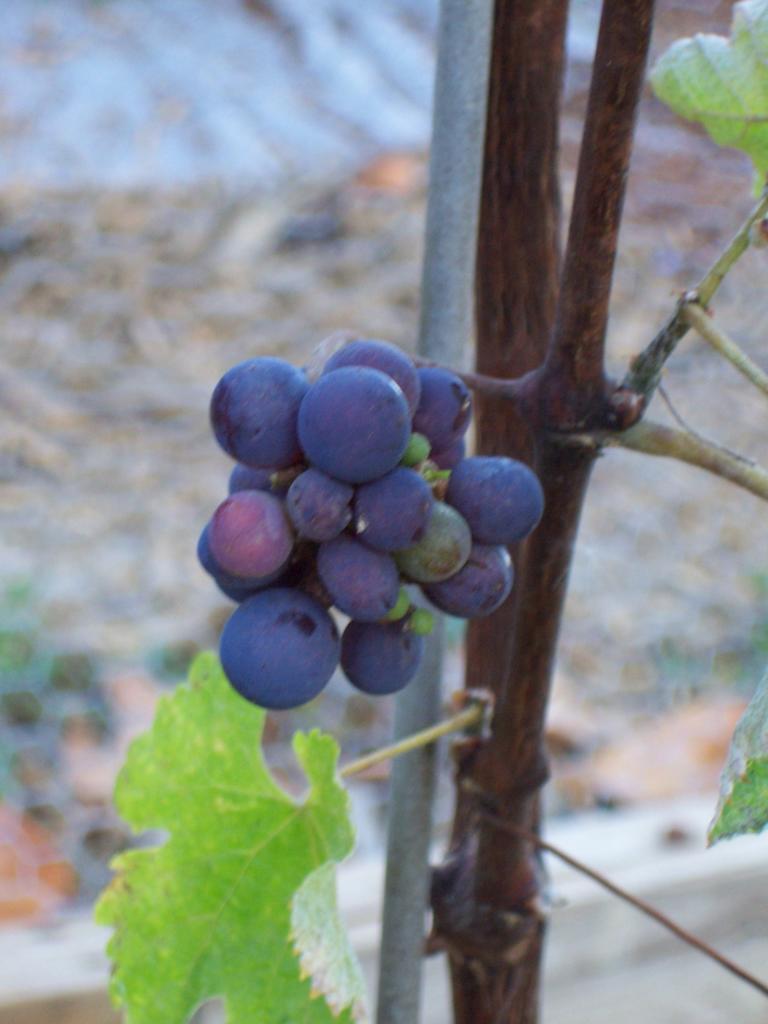
I pinched off or pruned all the grape clusters from my vines this year before they ever had a chance of reaching maturity. Except for one plant. It was the most vigorous and so I rewarded it by letting it have a single cluster.

It was not quite sure what to do. But, it did manage to create a small cluster of 20 berries.

They reached veraison very late and only darkened up after the Autumnal Equinox.

By October 15th, I could not restrain myself anymore and I plucked one of the ripest berries and sampled it. Still a bit sour, probably only 15% sugar and still pretty acidic and the seeds were still quite light green.

In any case, it was exciting. We should have had a party.
Next year.

timb

Saturday, October 15, 2005

A kit.

I have the opportunity to try out a wine kit. A box of grape juice concentrate, a handful of little packages filled with this chemical and that. 6 easy steps and in 6-8 months, I will have 6 gallons of chardonnay/semillon

It seems so easy. Sanitize the fermenter, add the juice, water, oak sawdust (sounds odd, no?) and yeast. Close it up, set it aside, let it go.

Well, we will see. Check back in 6-weeks to find out.

Tim

Sunday, October 09, 2005

Picked, crushed and fermenting


A wonderful trip down to Hollister at lunch time. I arrived at 11:00am and met the grower. He is living my dream, well, not quite. I would have more vines and less trees. But, to each his own.

I got there and inspected the fruit. Very clean, no mold or mildew. Not a lot of bird damage. I split open a few berries. The sees were a bit green still, even though it was late in the season. I found out that these fine are very young. 3 yrs. So they probably are not quite used to being the foundation for great wines yet, but still very tasty. Brix came in at 24.2 from the refractometer. 25 from the hydrometer. I did a pH strip. 3.5. Right on the edge.


5 minutes on the crusher/stemmer and I was on my way home with 200 lbs of must.

When I titrated at home, I was a little disappointed at the TA. 5.2 g/l of acid. I will assume that
the young grapes gave everything they could to get the sugar up to 25. Dropping the acid
to almost .5 percent.

I corrected the acid with some tartaric. Not too much. I would have like to get the TA back up to 6 but I did not want to drop the pH too low. So, I hit a compromise. We will see. Also, I want to give the grapes, even though they are young, a chance to show what they can do. Faith. Yes, I do have faith.

White juice. It never ceases to amaze me. Red grapes make white juice. I took a sample at crush, and then another at 12 hours and a final at 24 hours. Each sample was deeper in color. I will post the pictures.

I started the yeast in a sucrose starter 12 hours after crush. Pitched it at 22 hours after crush.
By 36 hours, "mission control, we have fermentation".

Here we go. The magic begins.

I will keep you informed.

Cheers.

TimB

Sunday, October 02, 2005

Grapes are almost here

Harvest time is here. I heard from the grower this weekend. Harvest of the grapes I contracted is set for Thursday. By Friday, we will crush. Saturday will be pitched and then the magic starts.

I have been a bit worried about the weather. Cool and even some rain. I am hoping they are in good shape and I can keep the SO2 to a minimum.

I think about my choice of grapes: Cabernet Sauvignon. It is the grape for either the winemaker who likes to worry, because it comes in late. W Cab, you can only be sure that the grapes will be ready when they are ready, and no earlier. It is like playing chicken with fall. What will happen first. Do you wait for the grape to reach it's full ripeness, and risk getting caught at the end with
cool weather and rain that dooms you to mold? Or do you harvest a little early, happy that you got good clean berries, just a bit lower brix and higher TA, but no worries.

Or, do you stick it out. Don't turn off the road. Stare the autumnal season in the face and hold your ground. Because, you know, if you can wait those last few days or week, the grapes will reach that perfect balance of sugar, total acid and pH. And you will win.

Keeps the blood pumping anyway.

Cheers;

Tim

Tuesday, July 19, 2005

The search for grapes

I need grapes. Last year I bought 100 lbs of grapes through a local wine making shop.
He was able to arrange the purchase from a local wine maker.
It worked out real well. A couple days before the harvest, I got a phone call
with the date, time and location of where I could pick up the grapes.

I showed up with my 20 gal plastic fermenter at the winery. About 10 other small
wine makers were there and the truck with lugs of grapes. The grapes had been picked
the day before and one by one, we got our grapes. Some people took the grapes
whole. Taking them back to crush them at home or their winery. Others like myself
climbed up onto a wooden platform and got to run each lug of grapes through
the stemmer/crusher into a container.

I was the newbie in the crowd. First time making wine, first time buying grapes.
I was only buying 100 lbs, so there was a bit of grape envy of the guy buying 1000 lbs.

Other than the person buying 1000 lbs (who appeared agitated that he actually
had to listen to other people chat while his precious time was being wasted), everyone
was in a very good mood, crunching grapes and hauling stuff around.

I realize then that doubling to 200 lbs of grapes, or even tripling would probably not
be that much more work overall. So, this time I am going to try to get more grapes.

But, there has been a change in the winery that we got the grapes from. The owner
has sold the winery so it has thrown into question my ability get grapes this year.
So, we will see what we can do. I would hate to have buy juice this year.
We will see.

timb

Monday, June 20, 2005

Time for more book-smartz.

When you have a resource like UC Davis so close, you just have to take advantage of it. So much knowledge and experience available to the public. For Agriculture instruction and viticulture and enology in particular, Davis is second to none.

Last year, I took one of their weekend extension courses on vineyard management. What a treat that was. It was like summer camp for grown ups. The instructors, Donna Hirschfelt and Ed Weber, are both farm advisers from Davis who spend most of their time with their boots in the dirt, advising real growers with real problems. Their series of classes is called Small Vineyard Management and is made up of 4 classes, split up over the year dealing with topics applicable for that time of the year. I was hoping to take the next in their series which deals with Integrated Pest Management, Crop Cover and Erosion control. Unfortunately, scheduling conflicts prevents me from taking that class.

Instead of the Small Vineyard Management class, I am going to be taking one of the Wine Making classes. The class will be taught by Ernie Farinias. He is a very experienced winemaker and the wine/cellar master at Davis with over 30 years experience in the wine industry. The class is a step by step course in winemaking. So, although I have experienced doing that with my own wines, now I can find out all the things I should have done. The class will focus on the first few days of the pick and crush. Three consecutive classes over two weekends. Day 1 - Crush red and white grapes. Day 2 - Rack and press and then the next weekend, rack again.

The course description describes using "traditional and non-traditional methods". I am not sure exactly what that means, but I have a feeling I should wash my feet real well the night before because I may be stomping.
I will keep you informed.

Unfortunately, the laws prevent students from ever taking their wine home. So we will have to find a similar vintage and pretend.

Cheers!

Timb

Wednesday, June 08, 2005

All Extract Beer. Kinda lazy ...

Kinda lazy, but so what. It is kind of a comfort zone.

It has been a long time since I brewed an all malt beer. I have been
thinking about it for a while. A full malt beer has such a rich flavor
and complexity, but lets face it: 6 hours to brew a beer, that is a big
chunk of time.

For the last few years, brewing an all malt has been been an exercize in
scheduling and negotiation. A full mash takes your full attention for a 6 hour
period. With kids, family, pet, household, job; 6 hours is hard to fit in. Brewing
after everyone goes to bed works but lets face it. It is a pain.

Roll back to my early brewing years. All malt, no mash, no sparge. Mix, boil,
cool and pitch. Well, not quite that simple, but you get the picture. I decided to
do a malt only brew, or close to it. So, with a bit of computer work to get the
proportions right, here is the recipe:

6 lbs American Gold DME
1 lbs 15L Crystal (in bag for boil)
2 oz Hallertau hops (2.2 Alpha - What's up with that? What ever happened to the 4 we used to have?)
2 oz Cascade hops (6% Alpha - these smell sooooooooo sweet)
Yeast - American Ale 1056 (a personal favorite: Med Flocculation. Good attenuation. Yummy grapefruit overtones)

The Boil:
Full boil DME in 6 Gal for 1 hour
Hallertau bittering hops added at 15 minutes
Crystal Malt in malt bag added at 30 minutes
1 oz Cascade hops added at 30 minutes (retain 1 oz for dry hopping)

Cool down
Rapid cooldown using heat exchanger to 77 Degrees F. (See note)

Transfer and Pitch:
Siphon to primary
Add 1 oz Cascade
Pitch with yeast

Starting Gravity: .045

Heat exchanger used 6 lbs of ice and primer of water to cool wort from 212 degrees
to 78 degrees in 14 minutes.

Rack at 6 days from primary (plastic) to secondary (glass)
Cloudy
Specific Gravity: 1.010

Rack at 10 days:
Much clearer, some yeast still in suspension
SG: 1.005

Check back for final transfer to Keg.


Timb

Sunday, June 05, 2005

Race to the Trellis

Ok, so watching my 1 year old vines race feverishly towards the
first trellis wire is about as exciting to non-invested observers as
watching a nail rust. But, I can't keep from checking on their
progress. And to be fair, they are not moving at a glacial pace.
Some of these babies are shooting up at an inch per day some days.

As of last Saturday, 3 of the vines reached trellis height and got "The
pinch". Yesterday, another one hit the wire and got it's top pinched
off. I expect in 3 weeks, they all will be there and then I can have
them training out their cordons.

I know, I know; you are all thinking: "Tim, Get a Life!" But this
isn't that bad a thing to be excited about. I admit, it is a little bit
of an escape for me. People look at my 2 dozen vines and see a fun
little backyard garden project while I look at it as a training ground
for those 20 acres of vineyard in my future. The neighbors see me
in the garage at 2 AM racking 10 gallons of wine from the carboys. Or
see me pressing 100 lbs of grapes with a hand cranked basket press and
think: "What the heck is he doing?" But I am making mental notes on how
this will scale up to the 80 ton of fruit from my 6,000 case winery.

May never happen, but don't tell me that when I am out talking to
my vines. That is our time together.

Thanks for visiting.

Timb

Wednesday, May 25, 2005

Who doesn't love sunshine?

Last week we removed 6 old Monterey Pins that had surrounded the vineyard.
These trees were getting old and were not in the best of health. In addition, some of them had
branches extending over part of the vines which was always worrisome. A strong wind
could have brought down the weakened branch. The placement also cast shadow across
many the vines for much of the day.

With these tree gone, the vines are getting full sun for much more of the day. And, it shows.
I swear that you can see them growing before your eyes. One of the vines has made the trip
from 30" to the 36" trellis in last 4 days. And none too soon too. I was beginning to worry
that the rabbit damage had set the 1 year old vines back so far that some would not reach the
trellis and begin the training out into the cordons. I think that all of them will now at least
reach the trellis early enough that I can being training out the horizontal arms.

Grapes this year?

I had planned on pinching off any clusters this year. Letting the vines concentrate on their
vegetative growth. But they have seemed very resilient to all that has been thrown their way
and with the vigor I see, I may reward them (and myself) with a few clusters on individual
vines that seem up to the challenge. I doubt that I will allow enough to actually include in
a fermentation, but we will see. Maybe I am letting my desire to see the fruit of my labor,
literally, cloud my better judgment to get a good foundation of growth on the young
vines

Stay tuned. I will keep fretting over this all season.

Cheers.

Timb